Every legal team has a playbook, whether or not it is written down. It is the set of answers a senior lawyer gives without looking anything up: we cap liability at twelve months of fees, we’ll go to twice that if we must, we never accept unlimited liability without the General Counsel. When it lives in people’s heads, it is applied unevenly and lost when they leave. When it is written down as data, it can be applied to every draft the same way.
In short
- A playbook is positions, not a template. For each clause: what the company prefers, what it will accept as a fallback, what it never accepts, how serious a deviation is, and who may approve one.
- Fallback language should be written in advance. If the acceptable compromise is already drafted, the redline is a copy, not a fresh piece of drafting under time pressure.
- Walk-away positions belong to a named person. Uncapped liability is not the deal team’s decision; the playbook says whose it is.
- Positions as data can be tested against every draft. A PDF playbook is read; a playbook stored as rules is applied, consistently, with the reason for each result.
The anatomy of a position
A usable playbook entry answers six questions about one clause, for one kind of contract and one side of the deal. Here is the limitation-of-liability position from the illustrative playbook in InsightContracts’ demo, for a fictional company, Calderbrook Systems, Inc. It is an example of the structure, not a recommendation and not legal advice.
| Field | Illustrative position PB-05: limitation of liability |
|---|---|
| Applies to | Master services agreements, SaaS order forms and supply agreements, either side |
| Preferred | “Except for the Excluded Claims, each party’s total aggregate liability … will not exceed the fees paid or payable under this Agreement in the twelve (12) months before the event giving rise to the claim. Neither party is liable for indirect, special or consequential damages.” |
| Fallback | The same cap at two times (2x) the fees in the twelve months before the claim |
| Walk-away | Uncapped liability for Calderbrook |
| Severity of a deviation | High |
| Approver | The General Counsel. Guidance: “An uncapped liability is the General Counsel’s decision, never the deal team’s.” |
Two things make this more than a style guide. The positions are written as clause language, so the fallback can be offered as it stands. And each position also has a rule that a machine can test: the preferred position is a cap of exactly twelve months with consequential damages excluded; the fallback is any cap between six and twenty-four months; the walk-away is a clause that says liability is uncapped.
Five outcomes for every clause
How InsightContracts places a clause against one playbook position. The walk-away test runs first.
The order matters. A walk-away is checked before anything else, so a clause can’t be “within the fallback” and unlimited at the same time. A fallback is acceptable and is recorded with what it missed (“the payment term: 30 days, wanted at least 45”), so a lawyer can see where the company gave ground without having to act on it. A deviation carries the playbook’s own severity and approver; nothing in the comparison invents a severity of its own.
Rules that say why
Each position’s rule is a set of constraints on the terms read from the clause: equals, at least, at most, one of, or contains. When a clause misses, the review says which constraint and what the draft said: “the cap (months of fees): 3 (wanted at most 24, at least 6)”. A lawyer can check every result against the quoted text.
What a playbook covers
The demo playbook has fourteen positions across the twelve clause types the reader finds. Some apply to every contract type; some only to certain types or to one side of the deal (intellectual property and payment terms read differently when the company is buying than when it is selling). One applies only where personal data is processed.
| Clause | What the illustrative position protects | Severity | Approver |
|---|---|---|---|
| Parties | The right contracting entity | Medium | Counsel |
| Term and renewal | No initial term beyond the fallback, short renewal terms | Low | Counsel |
| Auto-renewal notice | A notice window short enough not to miss | Medium | Counsel |
| Termination | A right to terminate for convenience | Medium | Counsel |
| Limitation of liability | A cap; never unlimited | High | General Counsel |
| Indemnity | Mutual and limited, no broad indemnity from the company | High | Counsel |
| Intellectual property (buyer and seller) | The company keeps its data and its platform | High | Counsel |
| Confidentiality | Long enough after the contract ends | Medium | Counsel |
| Data protection | A signed DPA wherever personal data is processed | High | Counsel |
| Governing law | A law the company accepts | Medium | General Counsel |
| Payment terms (buyer and seller) | Days to pay, in the company’s favour | Low | Counsel |
| Assignment | No assignment without consent | Medium | Counsel |
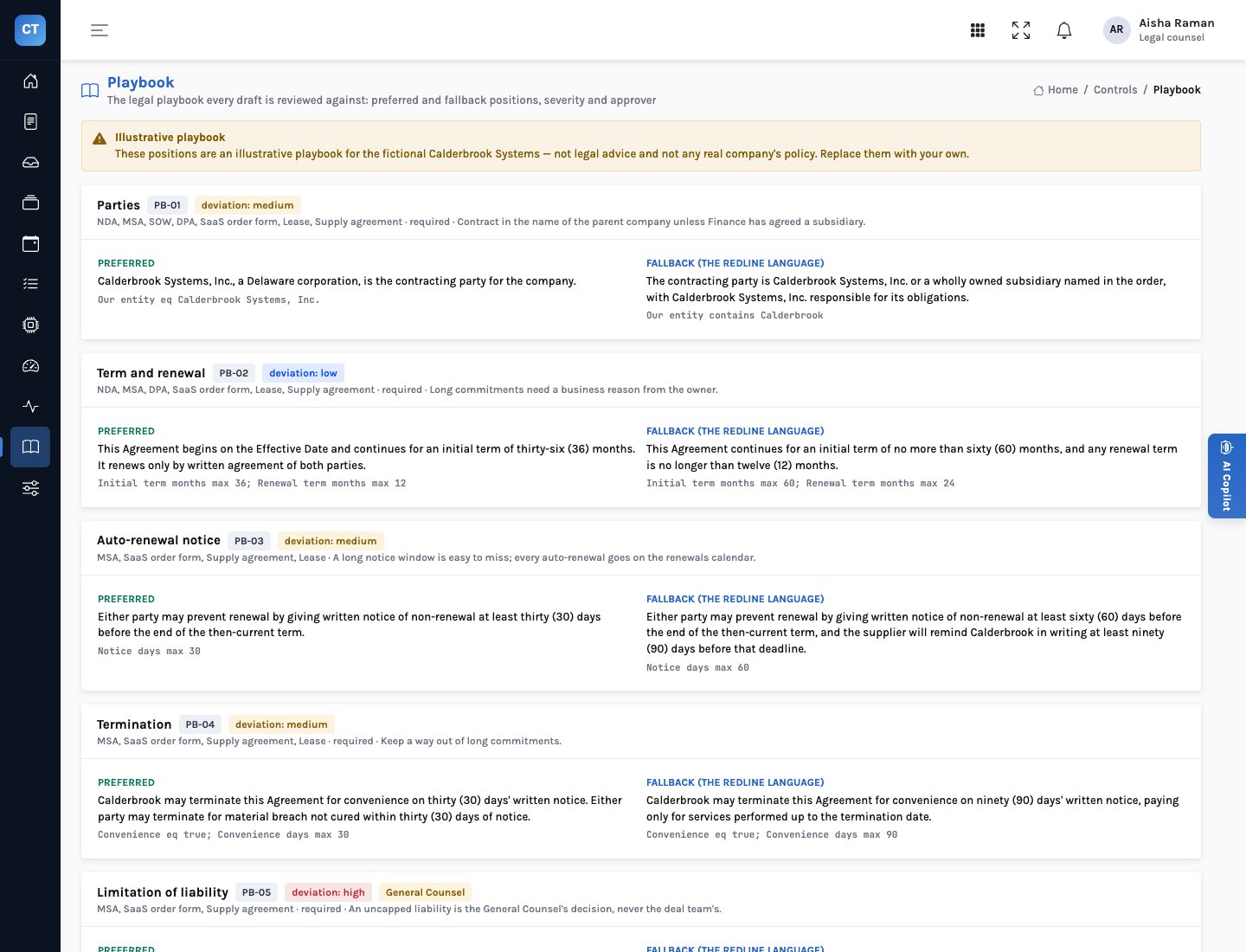
Why the fallback language matters most
The preferred position tells you what to hope for. The fallback language is what you actually send. When it is written in advance, approved once and stored with the position, a redline stops being a drafting exercise. InsightContracts uses it exactly that way: the suggested redline for a deviation is the playbook’s fallback text, verbatim. No model writes clause language, so the words a counterparty receives are words the legal team has already approved.
Read when someone remembers. Applied by memory. Updated by emailing a new version. Fallback language retyped, slightly differently, in each negotiation.
Applied to every draft by rule, with the reason for each result. Changed in one place. Fallback language copied word for word into the redline.
Writing your first one
Usually NDAs, supplier MSAs and SaaS order forms on the counterparty’s paper. Start there, not with the rare complex deal.
For each clause: what do we ask for, what do we accept, what do we never accept? Write the answers as clause language.
Decide which positions only the General Counsel may give up: typically liability, governing law and anything unusual.
A cap between six and twenty-four months; a notice period of at most sixty days; a governing law from a short list.
Check that the results match what a lawyer would have said. Adjust the rules, not the drafts.
Positions change with the business. Change them in one place.
Not legal advice
The positions quoted here come from the illustrative playbook of a fictional company. Your positions depend on your business, your jurisdictions and your risk appetite, and should be set by your own lawyers.
A playbook is the legal team’s judgement, made in advance.
Write the positions once, with the fallback language and the approver, and every draft can be measured against the same answers — with the page, the line and the reason on every result.