A redline is not a suggestion in a margin. The moment it reaches the counterparty it is the company’s position, in writing, and it will be quoted back in every round that follows. So the question of where a proposed redline’s words come from is not a technical detail. In InsightContracts the answer is short: from the playbook’s fallback language, copied exactly, and from nowhere else.
In short
- The redline is the playbook’s fallback text, verbatim. No model writes clause language. The redline drafter proposes what the legal team already approved as its fallback.
- Every change carries its reason. The finding says which playbook position the clause misses, by how much, and quotes the draft with its page and line.
- A redline is not a resolution. A redlined deviation still counts as open for approval until the counterparty’s next draft comes back within the playbook.
- If the counterparty ignores it, the review says so. When the next draft still deviates, the finding reopens with “the redline wasn’t taken”.
Why the words matter more than the speed
Generating contract language is the most visible thing AI can do in legal work, and the least useful thing to automate in a negotiation. A clause a model writes is new text nobody approved: it may be fluent, it may even be better, but it is not the position your General Counsel signed off, and a lawyer has to read it as carefully as if the counterparty had written it. The time saved drafting is spent again checking.
Most in-house teams already have the words they want. They are in the playbook: for each clause, a preferred position, a fallback the team will accept without escalation, and sometimes a walk-away point. The work a review needs is not writing; it is matching each clause in the draft to the right position and putting the approved fallback in front of the lawyer.
New language each time, phrased differently on every matter, that a lawyer must read line by line and nobody pre-approved.
The same approved language on every matter, with the playbook position it comes from (for example PB-05) named beside it.
How a redline is proposed
The playbook in InsightContracts is data: each position names the clause, the contract types it applies to, whether it is the buyer’s or seller’s view, a preferred rule and a fallback rule (constraints on the terms the reader takes from the clause, such as the cap in months of fees, at least 6 and at most 24), the deviation’s severity, who may accept it, and the preferred and fallback language. The review compares each clause’s terms with those rules and gives it one position: preferred, fallback, deviation, walk-away or missing.
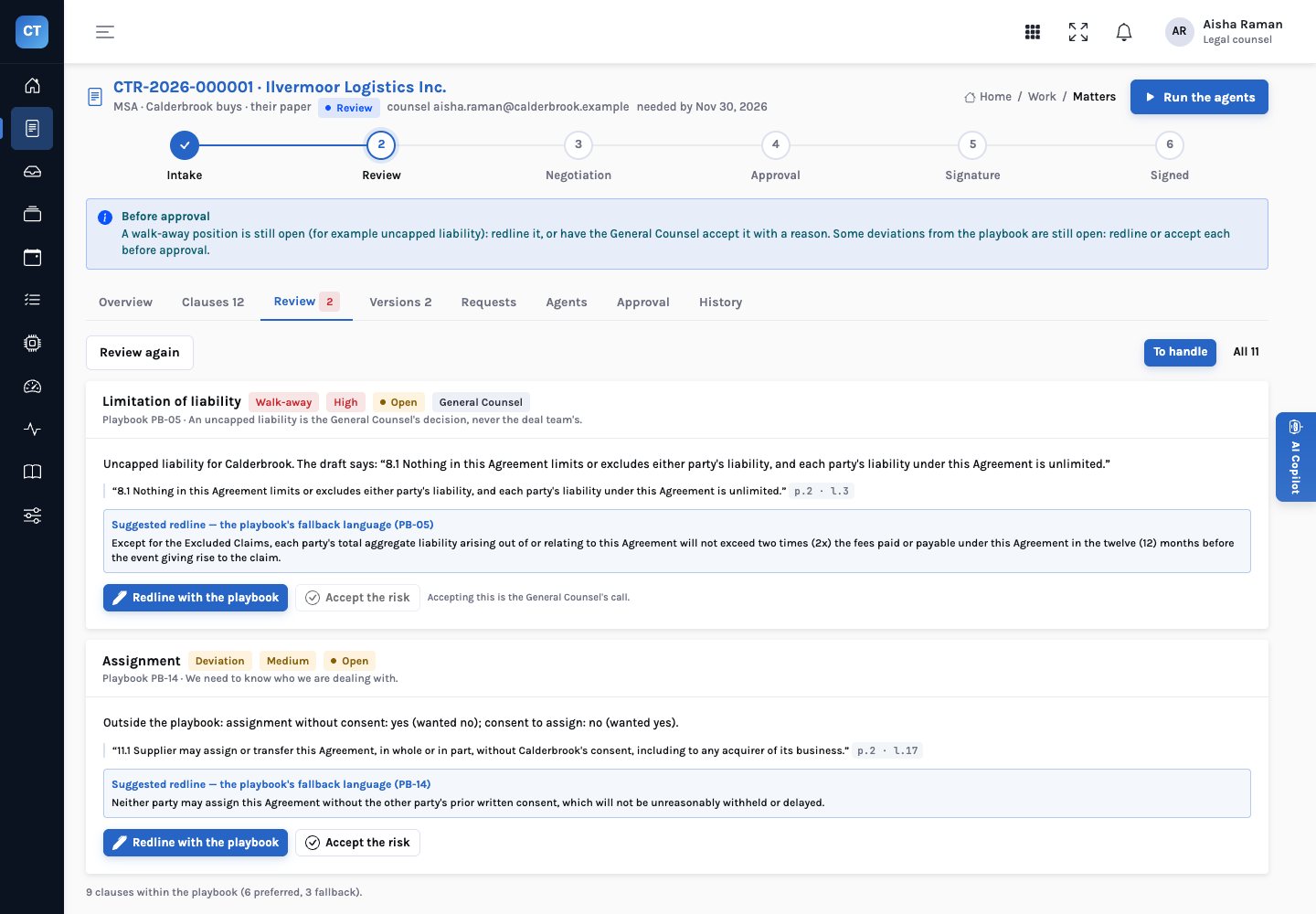
A deviation, a walk-away or a missing clause gets the position’s fallback language as its suggested redline. Nothing else is ever proposed.
Two kinds of finding never get a redline, because the playbook has no words for them: a missing exhibit and a missing Data Processing Addendum. Those are documents, not clauses, and the right move is to ask the counterparty for them. If someone tries to redline one, InsightContracts says so in a sentence: the playbook has no fallback language for this; ask the counterparty for the missing document instead.
Redline, accept or leave open
Each open finding has three possible states, and each is a person’s choice:
| Resolution | Who may choose it | What it means |
|---|---|---|
| Redlined | Any counsel; the redline drafter can propose it | The company asks for the playbook’s fallback language. The matter moves to negotiation. |
| Accepted | A counsel with a written reason; the General Counsel for a high-severity or walk-away deviation, or one the playbook reserves to the General Counsel | The company takes the risk. The reason goes on the decision record. An agent can never accept. |
| Open | Anyone, to undo a choice | Back on the list of things to handle before approval. |
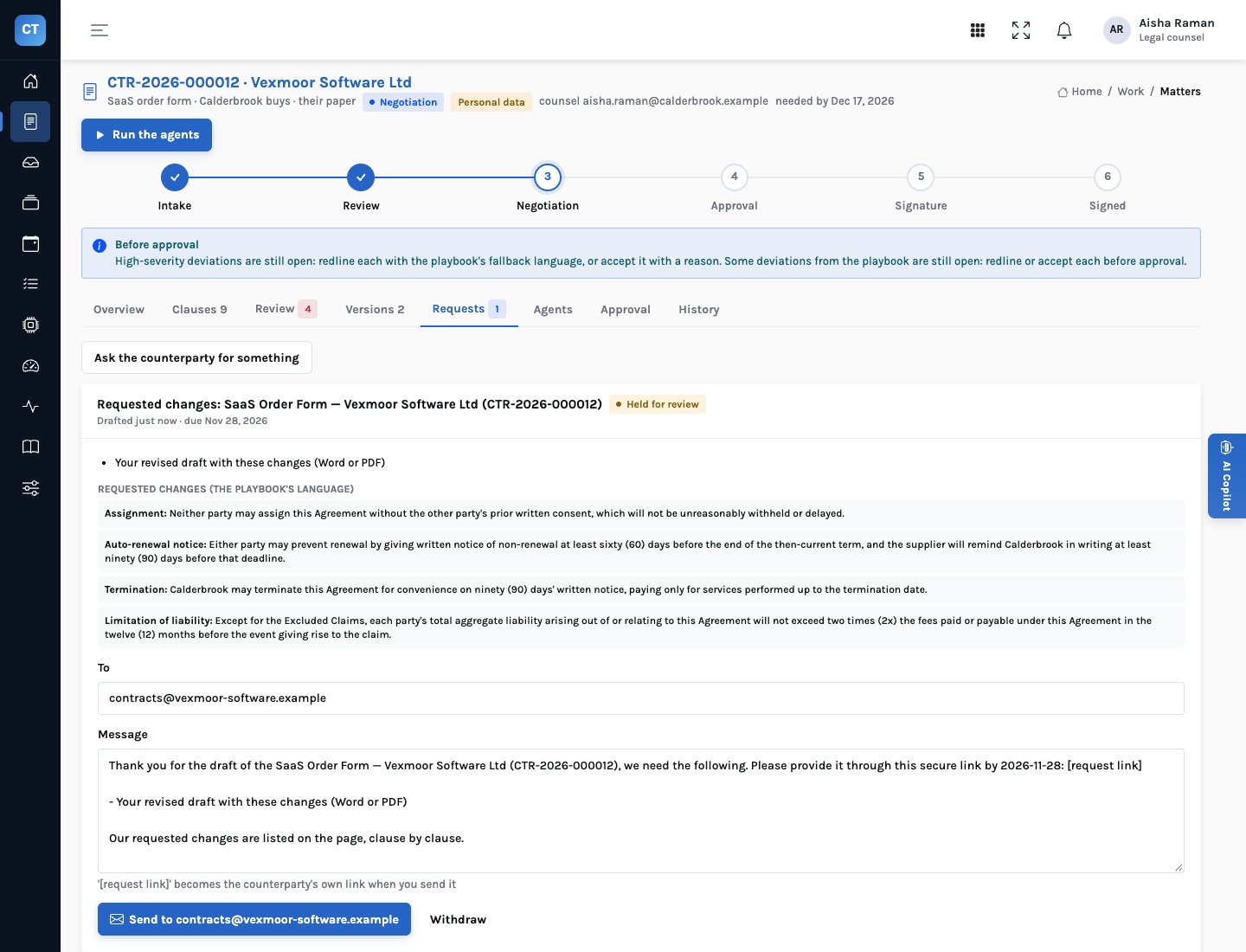
The redline drafter agent does the assembly: on each run it gathers the open deviations that have fallback language and prepares one decision, “Redline N clauses with the playbook’s fallback language”, listing each clause and the exact text. When the counsel accepts it, each finding is marked redlined with the note the playbook’s fallback language (PB-xx), accepted from the redline drafter, and a redline package is drafted as a request to the counterparty and held.
What happens on the next draft
Here is the part most redline tools leave to memory. A redline the company asked for is only worth something if the next draft takes it. InsightContracts reviews every new version against the playbook again and keeps each finding by a fingerprint, so a finding on version 2 is the same finding as on version 1, with its history.
A redlined finding stays on the approval controls’ count until the counterparty’s draft settles it.
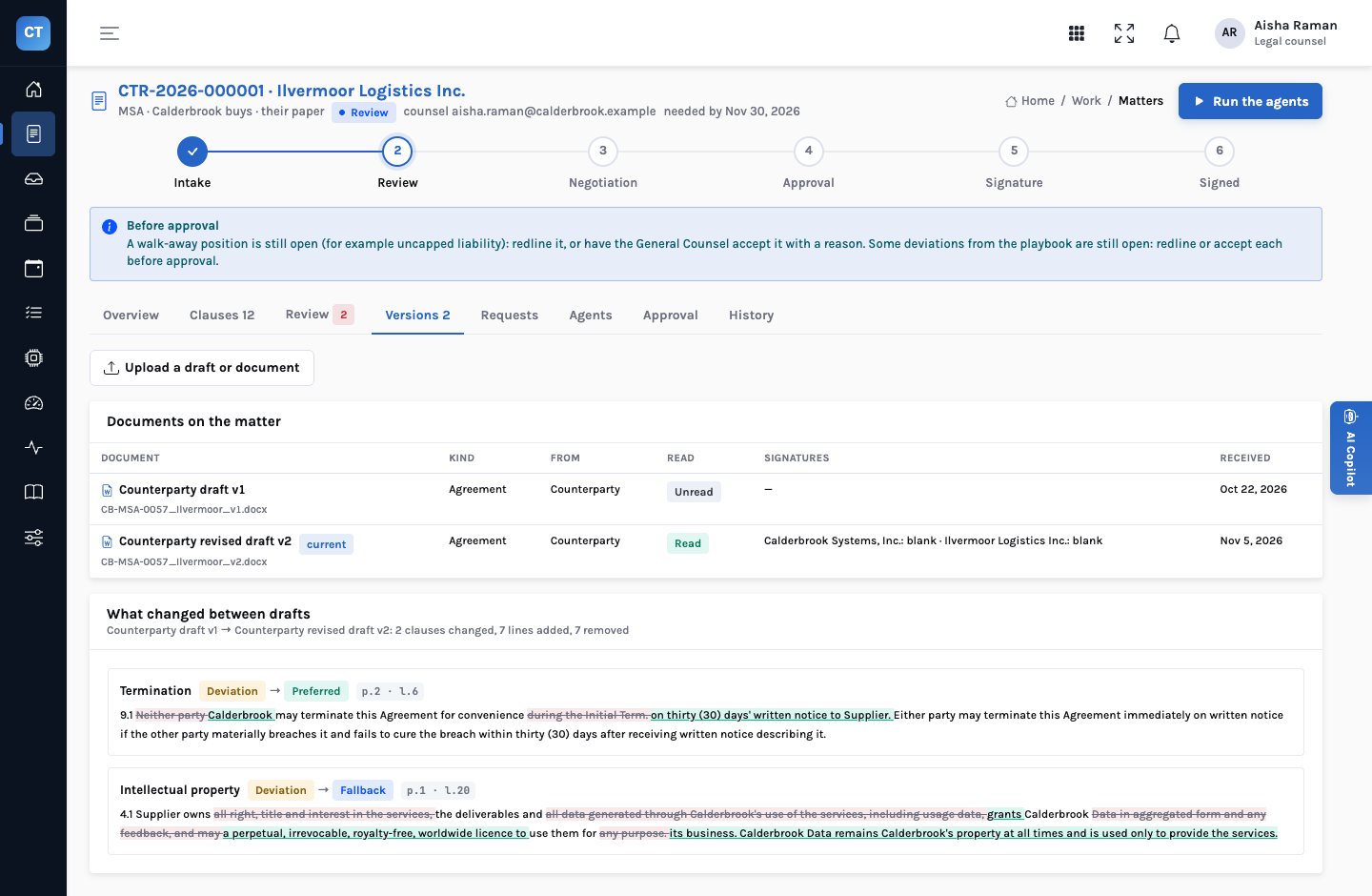
The version comparison shows the same thing from the text’s side. On the demo matter with Ilvermoor Logistics, the counterparty’s second draft moved termination from a deviation to the preferred position and intellectual property from a deviation to the fallback, word by word on screen, while the liability clause stayed unlimited.
Why a redlined deviation still blocks approval
It is tempting to treat “we asked for it” as done. But until the counterparty agrees, the signed contract would still say what the draft says. The approval controls count open and redlined deviations, so a matter can’t be approved for signature on the strength of a request the other side hasn’t answered.
Keeping the playbook honest
A playbook that only ever produces redlines nobody accepts is telling you something. Because every resolution is recorded with its position code, legal operations can see which fallbacks counterparties routinely take, which they routinely refuse, and which deviations are accepted again and again with the same reason. Those are the edits to make to the playbook, by people, with the General Counsel’s approval.
For the General Counsel
The company’s negotiating positions are applied the same way on every matter, in words you approved.
Every accepted risk has a reason and a name on it; the high ones have yours.
For legal operations
Counsel stop retyping fallback clauses and start deciding which ones to push.
Which fallbacks counterparties take is visible per position, which is where playbook changes come from.
For the board
No AI-written contract language reaches a counterparty.
Contract positions are consistent, auditable and owned by the legal function.
The model can explain a deviation. It must never write the remedy.
InsightContracts uses a language model, when one is switched on, to phrase summaries over numbered facts; any sentence carrying a name or number that isn’t in the facts is thrown away. Clause language is different: the only words it ever proposes are the ones your playbook already contains.
The demo’s playbook, its fourteen positions and the company, Calderbrook Systems, Inc., are fictional and illustrative. Nothing here is legal advice.