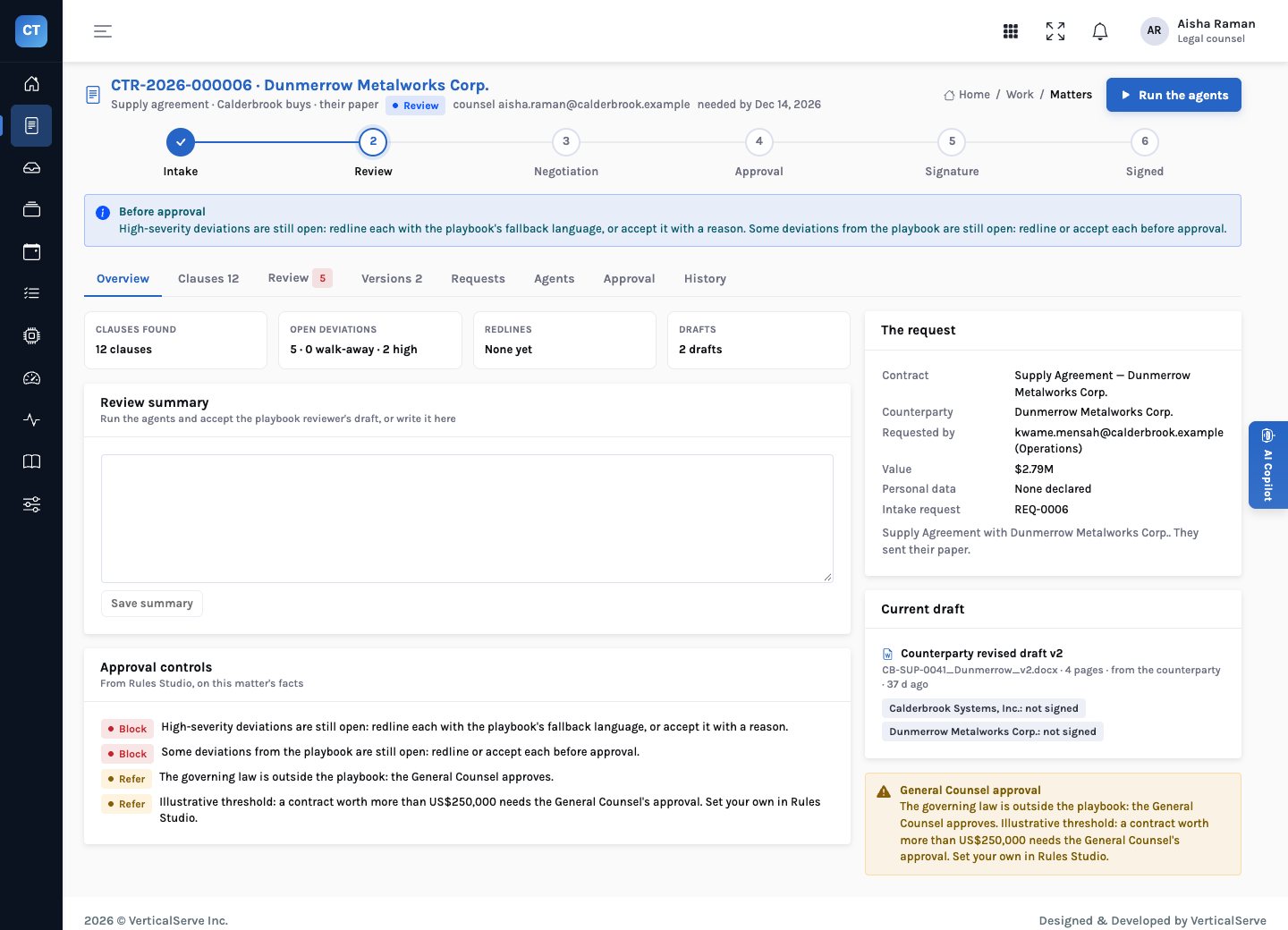
Dunmerrow Metalworks wants to supply Calderbrook for three years, US$2.79 million in total, on its own paper. Its second draft is better than its first: it dropped a one-sided indemnity and opened a way out for convenience. It is still outside the playbook in five places. Liability is capped at three months of fees. The supplier claims the data generated through Calderbrook’s use of its services. Confidentiality lasts one year. Notice of non-renewal is due ninety days ahead. And the contract is governed by California law. Five findings, two of them high, two of them for the General Counsel. The question isn’t what is wrong. It is what to do first.
In short
- Triage is a property of the findings, not the reader’s mood. Each finding carries the playbook’s severity and approver, so the order of work and who owns each decision are known before anyone starts.
- The playbook decides the redline. Every one of the five has fallback language the counsel can send verbatim; none of it is written by a model.
- Some decisions are the General Counsel’s from the start. The liability cap and governing law are reserved to the General Counsel in the playbook; the counsel can redline them but not accept them.
- The controls show the whole path to approval: two block until the deviations are handled, two refer the approval to the General Counsel.
The situation
This matter is on InsightContracts’ demo data: Calderbrook Systems, Inc. and Dunmerrow Metalworks
Corp. are fictional, and the playbook is illustrative, not legal advice. The matter is
CTR-2026-000006, from intake request REQ-0006: a supply agreement
(CB-SUP-0041) on Dunmerrow’s paper, Calderbrook buying, owned by Operations. No
personal data is declared.
| On this matter | |
|---|---|
| Contract | Supply agreement, counterparty’s paper; Dunmerrow Metalworks Corp., a Colorado corporation |
| Value and term | US$2,790,000 (US$930,000 a year); 36-month initial term, renewing for 12 months |
| Drafts | v1 received Oct 4, 2026; v2 CB-SUP-0041_Dunmerrow_v2.docx, 4 pages, received Oct 15, 2026 |
| Exhibits | A (Products and Prices) and B (Insurance Requirements), both referred to and both attached |
| Against the playbook | 3 preferred, 3 fallback, 5 deviations open (2 high, 3 medium) |
The five findings
| Clause | Playbook | Severity | Who can accept it | What the draft says |
|---|---|---|---|---|
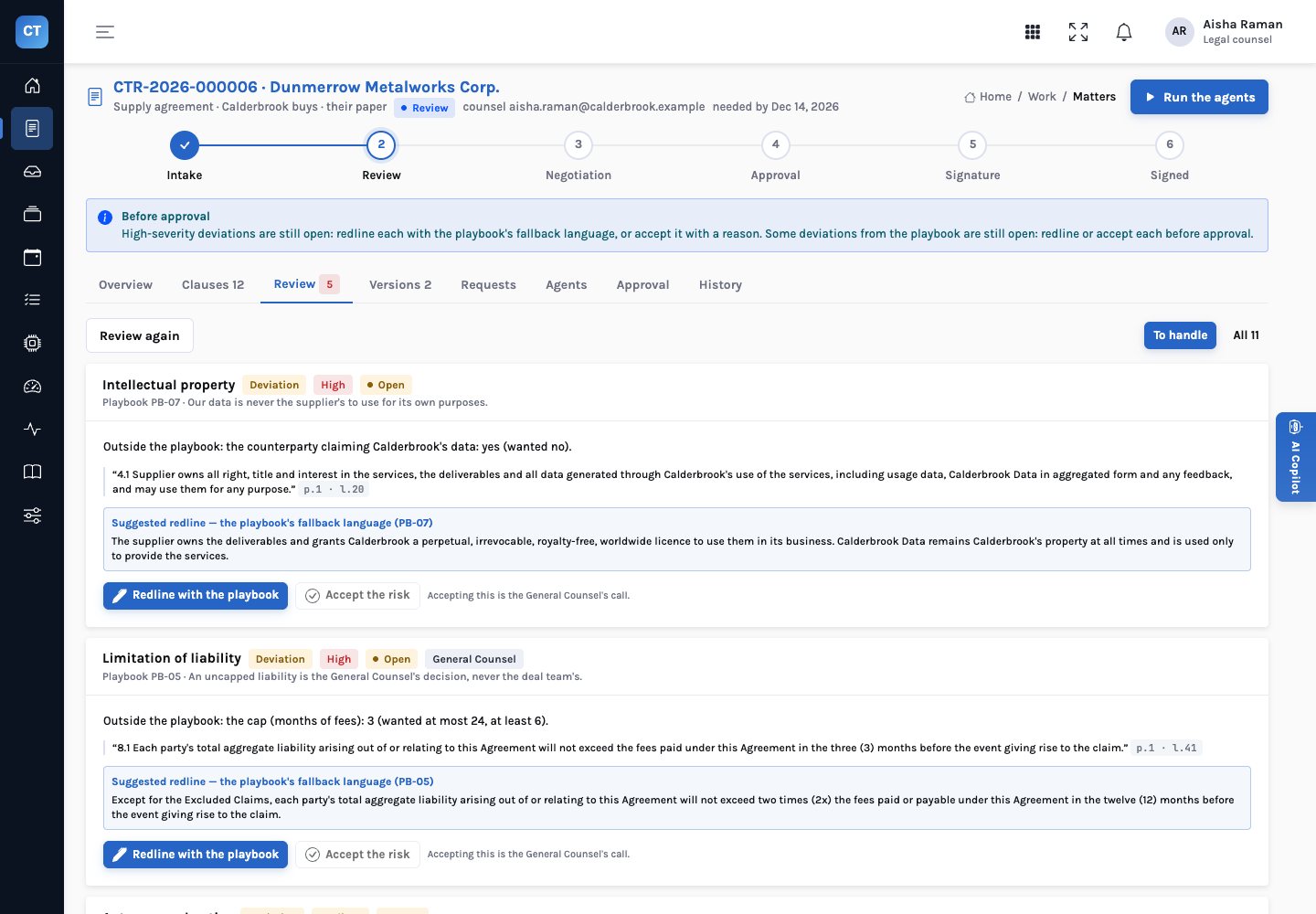
| Limitation of liability | PB-05 | High | General Counsel | “8.1 Each party's total aggregate liability arising out of or relating to this Agreement will not exceed the fees paid under this Agreement in the three (3) months before the event giving rise to the claim.” (page 1, line 41) |
| Intellectual property | PB-07 | High | General Counsel (high severity) | “4.1 Supplier owns all right, title and interest in the services, the deliverables and all data generated through Calderbrook's use of the services, including usage data, Calderbrook Data in aggregated form and any feedback, and may use them for any purpose.” (page 1, line 20) |
| Governing law | PB-11 | Medium | General Counsel (reserved by the playbook) | “12.1 This Agreement is governed by the laws of the State of California …” (page 2, line 16) |
| Auto-renewal notice | PB-03 | Medium | Legal counsel, with a reason | “… written notice of non-renewal at least ninety (90) days before the end of the then-current term.” (page 1, line 12) |
| Confidentiality | PB-09 | Medium | Legal counsel, with a reason | “These obligations continue for one (1) year after this Agreement ends.” (page 1, line 27) |
The reasons each is outside the playbook are stated in the playbook’s own terms. The liability cap: “the cap (months of fees): 3 (wanted at most 24, at least 6)”, so three months is below the fallback range. Confidentiality: “1 (wanted at least 3)” years. Notice: “90 (wanted at most 60)” days. Governing law: California, where the playbook accepts New York, Delaware or Ohio. The guidance beside each finding is the playbook’s too: “Foreign law needs the General Counsel (outside counsel costs)”, “Product roadmaps stay sensitive for years”, “A long notice window is easy to miss; every auto-renewal goes on the renewals calendar.”
Why five findings go wrong
A single deviation gets a lawyer’s full attention. Five at once get triaged in someone’s head, and three things tend to happen:
- The easy ones go first. Confidentiality and the notice period are quick to fix, so they are fixed, and the round goes back to the counterparty without the hard ones.
- Trades are made across clauses the counsel doesn’t own. “We’ll accept California law if you lift the cap” is a reasonable trade, but both halves of it are the General Counsel’s in this playbook.
- The quiet clause gets through. A one-year confidentiality term doesn’t look dangerous on a supply agreement, until the supplier has seen product specifications that stay sensitive for years.
A triage the playbook already decided
Severity and approver come from the playbook row. The counsel can redline all five; only the General Counsel can accept the first three.
Because severity and approver are on each finding, the order of work falls out of the data. The two high-severity findings are what most block approval and what the counterparty should hear about first. Governing law is medium but reserved: the counsel can propose Delaware, the playbook’s fallback, but if Dunmerrow holds out for California, the decision to accept it goes up. The two medium findings are the counsel’s own: redline them, or accept with a reason.
| Finding | The redline (the playbook’s fallback language, verbatim) |
|---|---|
| Limitation of liability (PB-05) | “Except for the Excluded Claims, each party's total aggregate liability arising out of or relating to this Agreement will not exceed two times (2x) the fees paid or payable under this Agreement in the twelve (12) months before the event giving rise to the claim.” |
| Intellectual property (PB-07) | “The supplier owns the deliverables and grants Calderbrook a perpetual, irrevocable, royalty-free, worldwide licence to use them in its business. Calderbrook Data remains Calderbrook's property at all times and is used only to provide the services.” |
| Governing law (PB-11) | “This Agreement is governed by the laws of the State of Delaware, without regard to its conflict-of-laws rules, and the parties submit to the exclusive jurisdiction of the courts located in Wilmington, Delaware.” |
| Auto-renewal notice (PB-03) | “Either party may prevent renewal by giving written notice of non-renewal at least sixty (60) days before the end of the then-current term, and the supplier will remind Calderbrook in writing at least ninety (90) days before that deadline.” |
| Confidentiality (PB-09) | “The confidentiality obligations continue for three (3) years after this Agreement ends, and for trade secrets for as long as they remain trade secrets.” |
What the second draft already gave
Between the first and second drafts, Dunmerrow moved on three clauses. Comparing them is how the counsel knows the round wasn’t wasted, and where the remaining argument is.
| Clause | Draft 1 | Draft 2 |
|---|---|---|
| Indemnity | Deviation: Calderbrook indemnifies the supplier against “any and all losses … arising out of or relating to this Agreement” | Preferred: a mutual IP indemnity with notice, cooperation and control of the defence |
| Termination | Deviation: no termination for convenience during the Initial Term | Fallback: either party on sixty (60) days’ prior written notice |
| Governing law | Deviation: England and Wales, courts in London | Still a deviation: State of California, San Francisco County |
The governing-law change is a reminder that “changed” isn’t “fixed”. The clause moved from one law outside the playbook to another, and the comparison shows it as deviation before and deviation after.
Who does what
Supply agreement on the counterparty’s paper, no personal data declared; nothing missing.
Twelve clauses from v2, every required clause found, each with page and line; exhibits A and B attached.
Six clauses within the playbook, five deviations open. Prepares a review summary listing the high-severity findings first.
Five redlines from PB-03, PB-05, PB-07, PB-09 and PB-11, verbatim, prepared as one decision for the counsel.
Accepts the redlines, or takes a different call on the two medium findings with a written reason. Raises any trade on liability, IP or governing law with the General Counsel.
The redline package is held on the Requests tab; the counsel sends it. Dunmerrow’s revised draft, uploaded through the link, becomes version 3 and is read, reviewed and compared at once.
Governing law outside the playbook and the value above the illustrative US$250,000 threshold both refer the approval to the General Counsel. The submitter can’t approve.
What the controls say
| Control | Outcome | On this matter |
|---|---|---|
| High-severity deviations open | Block | Liability cap and IP |
| Deviations open | Block | Five open |
| Governing law outside the playbook | Refer | State of California |
| High-value contract (illustrative threshold) | Refer | US$2.79 million is above the illustrative US$250,000 |
Two more controls are waiting in the wings. If the General Counsel accepts the liability cap or the governing law rather than redlining it, the control for positions the playbook reserves to the General Counsel refers the approval to the General Counsel as well. And redlined findings keep blocking until Dunmerrow’s next draft is within the playbook: sending the package moves the matter to negotiation, it doesn’t clear it.
What it means for each audience
For the General Counsel
The decisions reserved to you arrive marked as yours: the liability cap, the data, the governing law. Nobody trades them away in a round you didn’t see.
When you do accept one, your reason is on the finding and the approval comes back to you.
For legal operations
Five findings come with their order, their owner and their redline. The counsel’s first hour is spent on judgement, not on sorting.
One package covers the round, so the counterparty answers everything at once.
For the board
Supply agreements are long and expensive to unwind. The terms that decide what a supply failure costs, liability and governing law, get the most senior review automatically.
And a supplier’s claim on the company’s data is caught before it is signed.
What to be careful about
- Severity is policy. The demo’s severities and approvers are illustrative. A company that buys mostly from overseas suppliers might treat governing law very differently; set your own.
- Fallback isn’t a floor. The playbook’s fallback is the furthest the counsel can go without escalating. Most negotiations should start at preferred, and the counsel can always ask for more than the fallback.
- The parameters are read, the commerce isn’t. Three months of fees on a US$930,000 annual contract is a number the reader can extract. Whether it is enough to cover a bad batch of parts is a business question for the owner in Operations.
Five deviations is not five arguments. It is one plan.
Let the playbook set the order, the redline and the owner of each decision, and send the counterparty one package.