Vexmoor Software sends its own SaaS order form for a marketing automation platform. Nine clauses are in the draft. Five sit inside the playbook. Four don’t: a liability cap of three months’ fees, free assignment for the vendor, a ninety-day non-renewal notice and no right to terminate for convenience. The counsel’s job is to tell the vendor what the company needs instead, in words the company has already approved, and to make sure nothing leaves the building until she has read it.
In short
- Every requested change is the playbook’s own fallback language, verbatim. The redline drafter copies it; no model writes clause text.
- The agent prepares; the counsel accepts. One “Accept” on the redline drafter’s prepared decision marks four findings as redlined and drafts the package.
- The package is held. It sits on the Requests tab with the counterparty’s address and a message, until a person presses Send. An agent can’t send it.
- A redline isn’t a resolution. The approval controls still count the four deviations as open until the vendor’s next draft comes back inside the playbook.
The situation
This matter is on InsightContracts’ demo data: Calderbrook Systems, Inc., a company we invented,
with invented counterparties, contracts and an illustrative fourteen-position playbook. The matter is
CTR-2026-000012, a SaaS order form with Vexmoor Software Ltd, opened from intake request
REQ-0010 for the People team. Calderbrook is the buyer, the paper is the vendor’s,
personal data will be processed, and the order is worth US$76,000. The draft on the matter is the
vendor’s revised draft, version 2.
| Clause | What the draft says (page, line) | Playbook position | Severity |
|---|---|---|---|
| Limitation of liability | “…will not exceed the fees paid under this Agreement in the three (3) months before the event…” (p.1, l.26) | Deviation: the cap is 3 months of fees; the fallback allows 6 to 24 (PB-05) | High |
| Assignment | “Vendor may assign or transfer this Order Form… without Calderbrook’s consent…” (p.1, l.38) | Deviation: consent required (PB-14) | Medium |
| Auto-renewal notice | “…written notice of non-renewal at least ninety (90) days before the end of the then-current term.” (p.1, l.12) | Deviation: at most 60 days (PB-03) | Medium |
| Termination | “6.1 Neither party may terminate this Agreement for convenience during the Initial Term.” (p.1, l.30) | Deviation: Calderbrook must be able to terminate for convenience (PB-04) | Medium |
| Governing law | State of Delaware (p.2, l.3) | Fallback: within the playbook | — |
| Payment terms | 30 days (p.1, l.17) | Fallback: within the playbook | — |
| Data protection / DPA | DPA attached as Exhibit C (p.1, l.20) | Preferred | — |
Parties and the term are at the preferred position too. So the negotiation is about four clauses, and each one has a fallback the company has already agreed it can live with.
Why redlining goes wrong
- Every lawyer writes it differently. Without approved language, the same position is drafted five ways by five people, and the company ends up with five slightly different liability caps across its suppliers.
- The ask drifts from the policy. Under deadline, a counsel asks for “something reasonable” rather than the fallback, and the record of what was asked and why is an email thread.
- Things go out too early. A tool that drafts and sends in one step means nobody reads the package as the counterparty will.
- Nobody checks the answer. The vendor’s next draft is accepted on a skim, and a change that was asked for and not made slips through.
The counsel retypes each position from memory or an old contract, emails the marked-up draft and waits. Whether the next draft took the changes is checked by eye.
Each change is the playbook’s fallback text with its position number. The package waits for the counsel to send it. The vendor’s next draft is read and reviewed against the same positions.
What the agents prepared
When the matter was opened, the agents ran in order: the intake agent (nothing missing; the DPA is attached as Exhibit C), the clause extractor (nine clauses found, each with its page and line), the playbook reviewer (five within the playbook, four deviations open) and the redline drafter. The redline drafter doesn’t write anything of its own. For each open deviation it takes the playbook row’s fallback text and proposes it as the redline: PB-03, PB-04, PB-05 and PB-14.
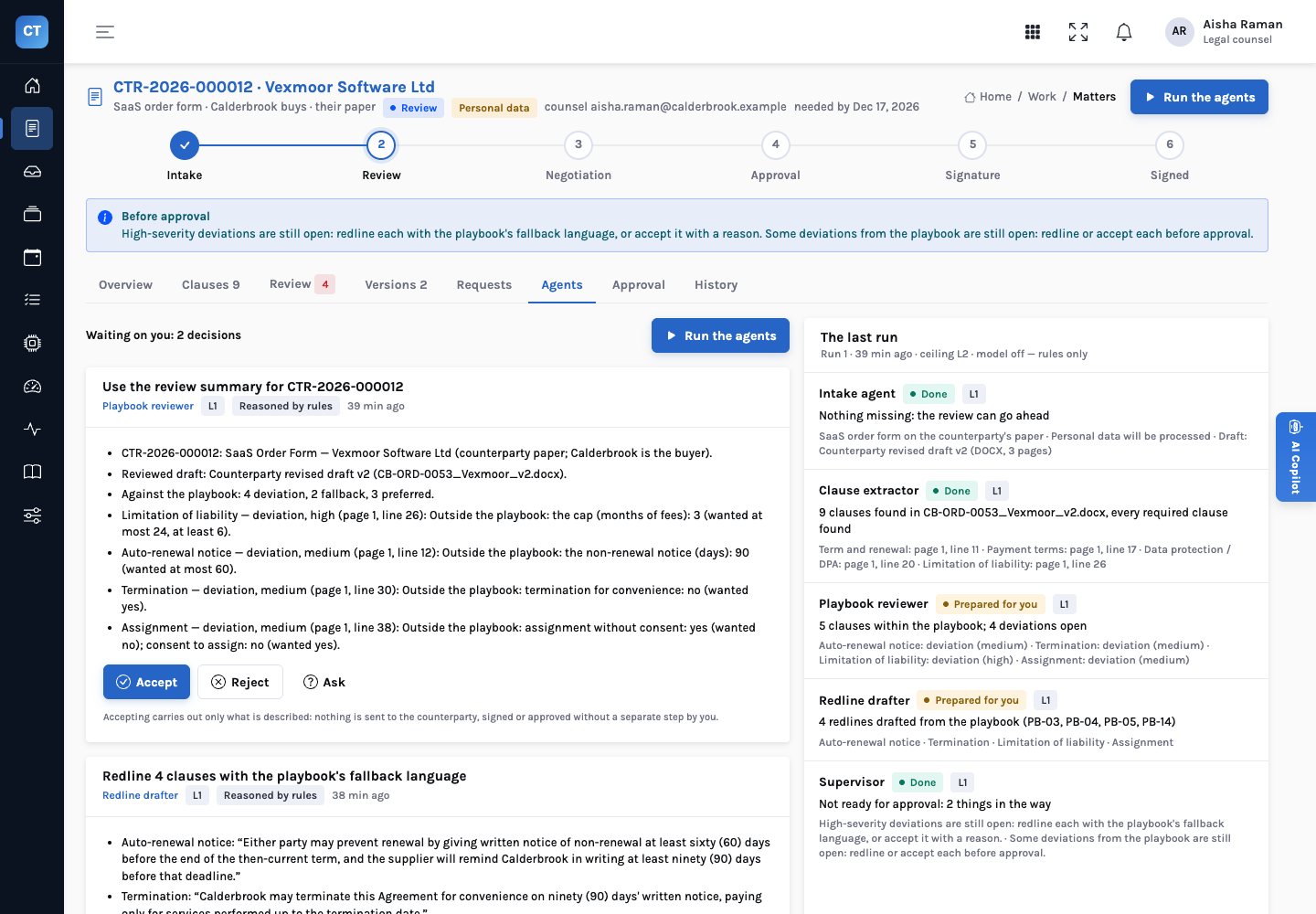
Two decisions wait on the counsel: use the drafted review summary, and redline four clauses with the playbook’s fallback language. The card says plainly what accepting does: it carries out only what is described, and nothing is sent, signed or approved without a separate step by a person.
Two separate human steps: accepting the redlines, and sending them.
The counsel accepts
Aisha Raman, the counsel on the matter, reads the four proposals against the four quoted clauses and accepts. Four things happen, each recorded in the matter’s history under her name: each finding is marked redlined with the note “the playbook’s fallback language (PB-05), accepted from the redline drafter” (and the same for the other three); the matter moves to Negotiation; and a request to the vendor is drafted and held.
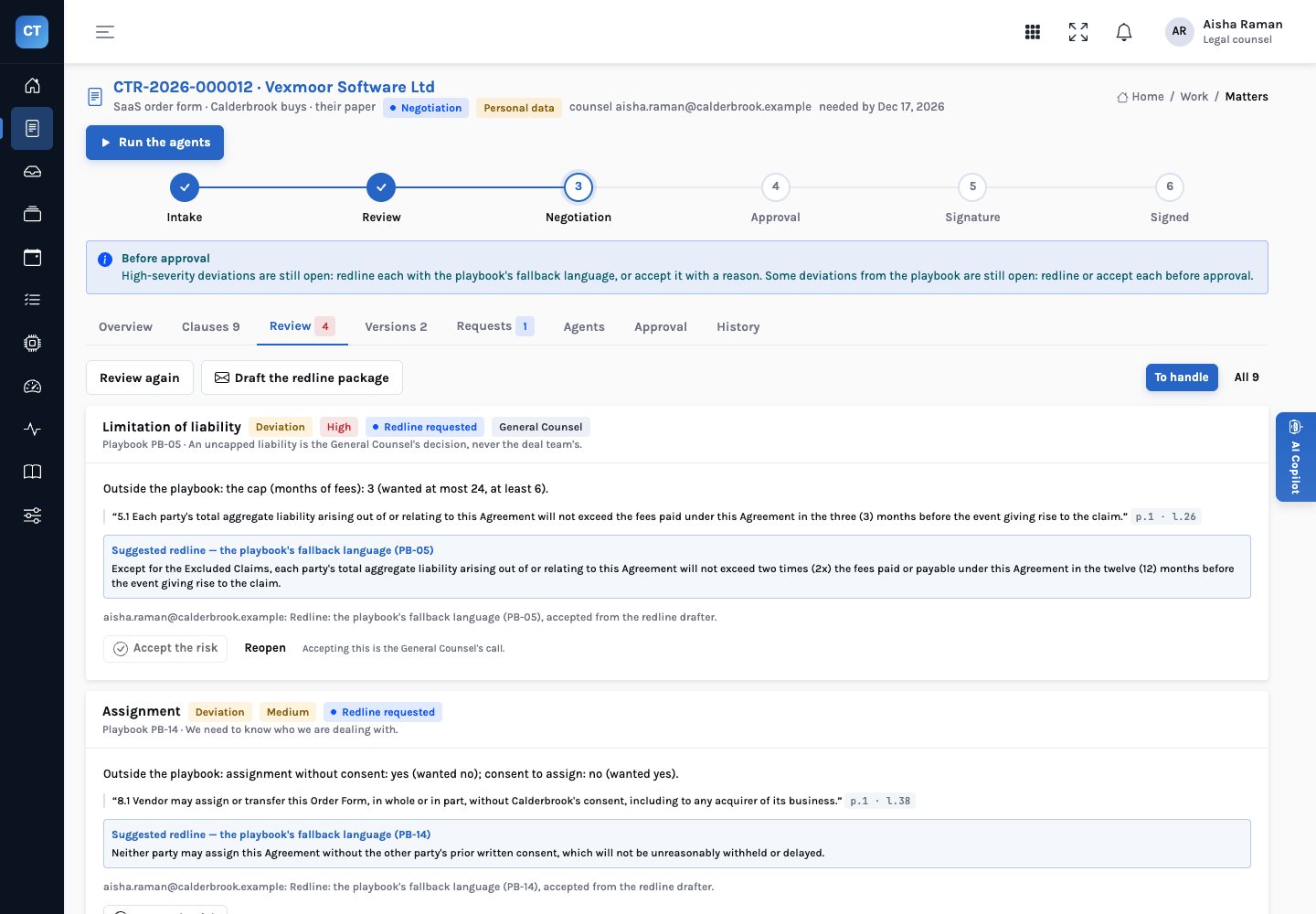
Redlining a General Counsel position is allowed; accepting it isn’t
The liability cap is a high-severity deviation the playbook reserves to the General Counsel. A counsel can still ask the vendor for the fallback position, because asking for the playbook’s own language gives nothing away. What she can’t do is accept the three-month cap: that needs the General Counsel, with a reason on the decision record.
The package, held
The drafted request sits on the Requests tab with the status Held for review. It asks for one thing, “Your revised draft with these changes (Word or PDF)”, lists the four requested changes clause by clause in the playbook’s words, and carries a due date seven days out (28 November 2026). The recipient is the vendor’s contracts address from the intake request, and the counsel can edit the address, the subject and the message.
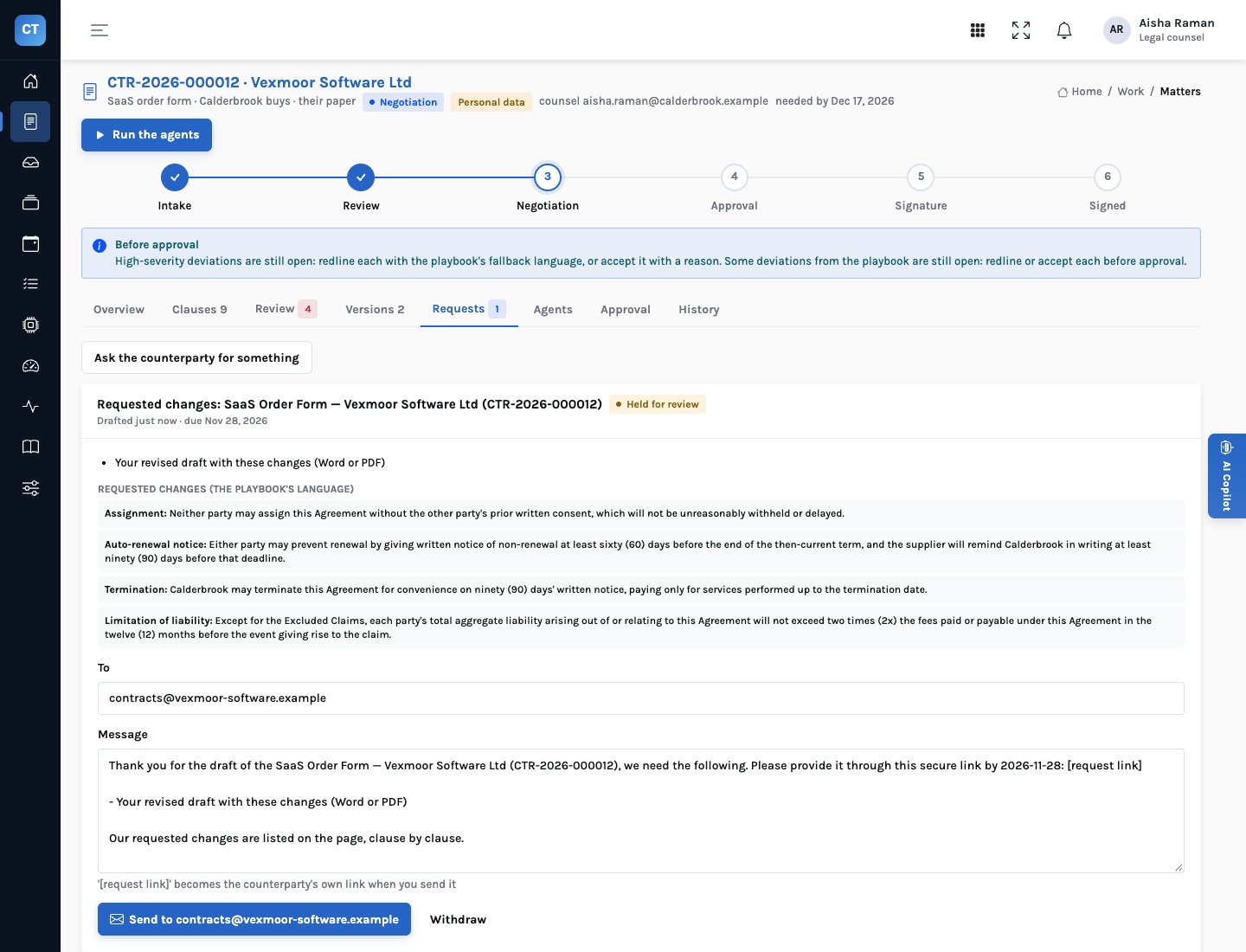
The message keeps a placeholder, [request link]. The product refuses to save a message
without it, because it becomes the vendor’s own link when the request is sent. In the demo this
request has not been sent.
When the counsel sends it
Sending is a person’s step, and the API refuses it from an agent. On Send, InsightContracts
creates a random link token, shows the link once and keeps only a hash of the token, so a link
can’t be recovered from the database later. Whether the email is actually delivered depends on
the deployment: with CONTRACTS_COMMS_LIVE off, the request is a dry run, the history says
“not delivered”, and the counsel sends the message herself.
The vendor’s answer becomes the next version, reviewed against the same positions.
The vendor opens the link without an account, sees the requested changes clause by clause and uploads a revised draft. That draft becomes the matter’s next version: it is read, reviewed against the playbook and compared with the previous version clause by clause and word by word. A clause that now sits inside the playbook resolves its finding automatically, with the note “Within the playbook on the latest draft.” A clause the vendor didn’t change reopens, with “The counterparty’s latest draft still deviates: the redline wasn’t taken.”
Who does what
Nine clauses with page and line; four deviations, each with the playbook’s severity.
PB-03, PB-04, PB-05 and PB-14, copied verbatim. Prepared, not applied.
Accepting redlines the four findings and drafts the package. Rejecting is recorded and counts against the agent’s agreement rate.
Edit the address and the opening if needed; keep the link placeholder.
Creates the no-login link. An agent can’t send.
The revised draft is read, reviewed and diffed. Resolved or reopened, finding by finding.
A remaining high-severity or GC-reserved deviation is the General Counsel’s to accept, with a reason.
Why the controls still say “open”
After the counsel redlines all four clauses, the banner on the matter still reads “High-severity deviations are still open.” That is deliberate. The approval controls count a deviation as open whether it is untouched or redlined, because a redline is a request, not an agreement. The matter can’t be submitted for approval until the vendor’s draft is within the playbook or someone with the authority accepts what remains.
| Finding state | What it means | Counts as open for approval? |
|---|---|---|
| Open | Outside the playbook, nothing done yet | Yes |
| Redlined | The fallback language has been asked for | Yes, until the next draft is reviewed |
| Accepted | The risk is taken, with a reason (General Counsel for high or reserved positions) | No; a GC-reserved acceptance refers approval to the General Counsel |
| Resolved | The latest draft is within the playbook | No |
What it means for each audience
For the General Counsel
Every change the company asks for is language it approved in advance. When a supplier pushes back, the conversation starts from a written fallback, not a blank page.
Positions reserved to you stay reserved: counsel can ask, only you can concede.
For legal operations
One accept turns a reviewed draft into a package the counterparty can answer. Agreement rates on the redline drafter show how often counsel uses what it prepares.
Nothing leaves without a person pressing Send.
For the board
Supplier terms converge on the company’s own positions instead of drifting contract by contract.
Each request, and each answer, is on the matter’s record.
What to be careful about
- The playbook is the product’s ceiling. Redlines are only as good as the fallback language in it. The demo’s playbook is illustrative and is not legal advice; yours should be written and owned by your lawyers.
- Sometimes the fallback is the wrong ask. A small order may not justify fighting for a liability cap. The counsel can reject the proposal and handle the clause another way; the rejection is recorded.
- Read the package before sending it. The held state exists so that someone does.
Ask in the company’s own words, and only when a person says so.
The redline drafter turns four deviations into four approved positions. The counsel decides whether to ask for them, and the next draft shows whether the vendor agreed.