A contract is a set of words the company will be held to. Any tool that reads those words, compares them with the company’s positions or proposes new ones is close to the core of legal judgement, and a General Counsel will be asked about it: by the board, by auditors, by the company’s own lawyers. The useful questions are not about which model is used. They are about where each word comes from, who decides, and what is on the record afterwards.
In short
- Ask where the clause language comes from. Text a counterparty will receive should be language your lawyers approved, not language a model generated on the day.
- Ask what the tool may do on its own. Reading and comparing can be automated; sending, accepting a risk, approving and signing should each be a person’s step, enforced by the system rather than by policy.
- Ask how a statement is traced to the document. Every finding should quote the page and line it rests on, so a lawyer can check it in seconds.
- Ask what happens with the model switched off. If the answer is “nothing works”, the model is supplying facts. If it is “the same findings, plainer wording”, it is explaining them.
Why the questions matter now
Lawyers using AI tools carry their usual professional duties with them: competence, confidentiality, supervision of the work, candour about what was done. The American Bar Association’s Formal Opinion 512 (2024) on generative AI tools discusses how those duties apply, and other professional bodies have issued guidance of their own. None of it forbids the tools. All of it assumes the lawyer understands what the tool did and checked it. A design that makes checking easy is therefore not a nicety; it is what lets a legal team use the tool at all.
Six questions, and the answers to look for
| Question | A weak answer | A strong answer |
|---|---|---|
| Where does each finding come from? | “The model reviewed the contract.” | Each clause is quoted with its page and line; each position comes from a written playbook rule. |
| Where does redline language come from? | Generated to fit the context. | The playbook’s approved fallback language, copied verbatim. |
| What can the tool do without a person? | “It’s configurable.” | It prepares. Sending to a counterparty, accepting a deviation, approving and recording a signature are refused for an agent. |
| Who approves what? | Whoever has access. | Controls decide what blocks and what goes to the General Counsel; the approver is never the submitter. |
| What is recorded? | Chat history. | Every agent step with its autonomy level; every decision with each control’s outcome and each clause’s resolution. |
| What if the model is off or wrong? | The feature stops. | The engines’ findings stand; the model only phrases them, and a sentence with a fact not in the inputs is discarded. |
How InsightContracts answers them
The reading is deterministic
The clause reader that turns a PDF or Word draft into twelve clause types is not a language model. It works from the document’s layout and wording, quotes every value with the page and line it came from (the same page and line in the PDF, the Word file and the text layer), and reports a clause it cannot find as missing rather than filling the gap. A scanned PDF with no text layer is refused in plain words.
The positions are the playbook’s
The comparison of each clause with the preferred, fallback and walk-away positions is a rule check against the playbook, which is data the legal team owns. Severity and approver come from the playbook row. The suggested redline is the playbook’s fallback language, verbatim.
The model explains, and is checked
Where a language model is used — to phrase a review summary, the opening of a request to a counterparty, or a short narrative of where a matter stands — it works from numbered facts the engines produced. A sentence carrying a name or number that isn’t in those facts is thrown away and the engine’s own wording stands. With the model switched off, every agent runs on its rules and says so; the copilot answers with the matter’s headline facts and says the model is off.
Facts come from the reader and the playbook. The model, when on, only phrases them, and its output is checked.
What the agents may and may not do
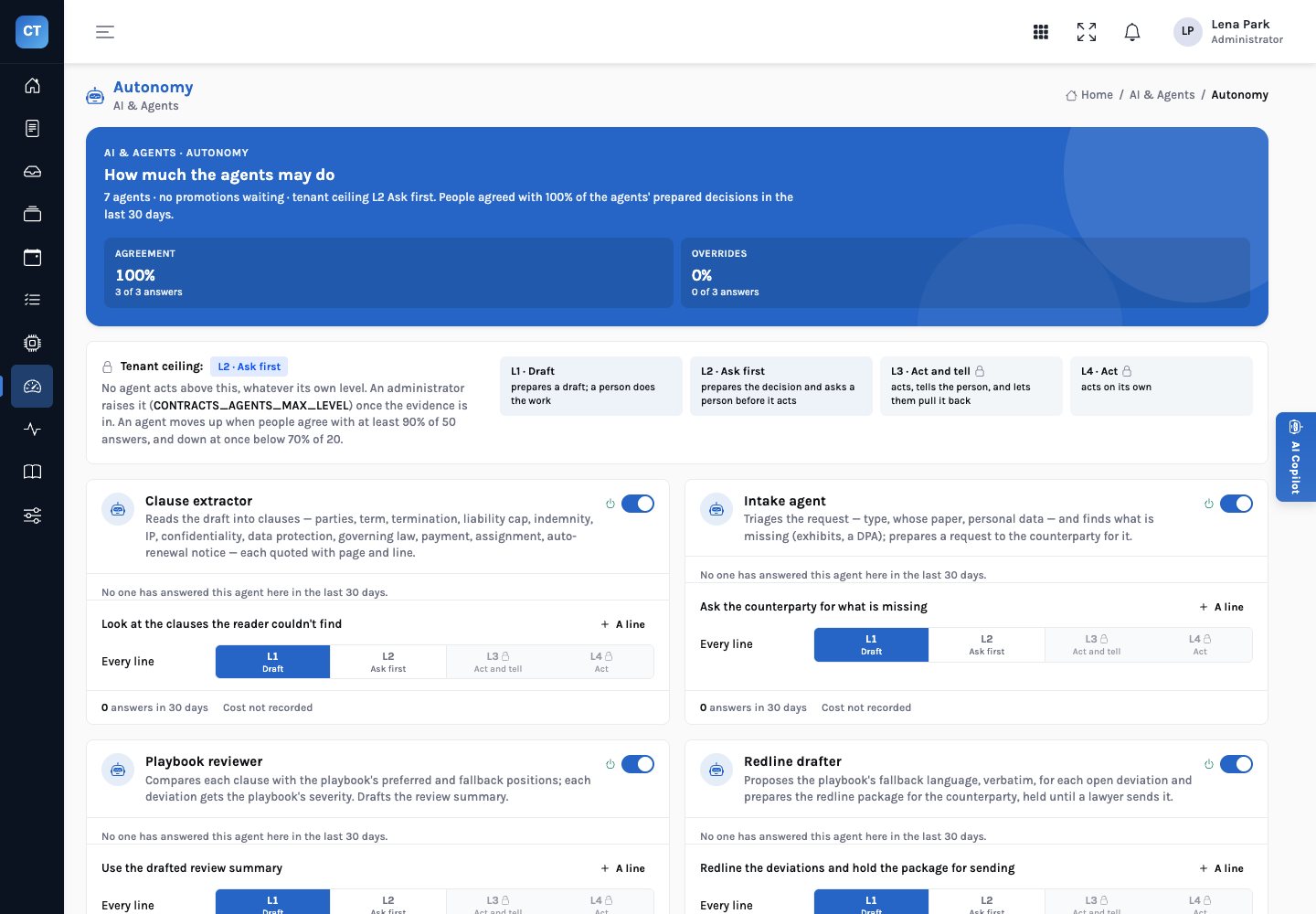
Seven agents work on contracts: intake, clause extractor, playbook reviewer, redline drafter and supervisor on a matter; obligations and renewals on the signed repository. Each prepares something — a request, a summary, a redline package, a submission, a renewal review — and the prepared decision waits for a person to accept, reject or ask.
| Level | Name | Meaning |
|---|---|---|
| L1 | Draft | Prepares a draft; a person does the work |
| L2 | Ask first | Prepares the decision and asks a person before it acts. The ceiling for every InsightContracts agent |
| L3 | Act and tell | Acts, tells the person and lets them pull it back. Locked |
| L4 | Act | Acts on its own. Locked |
The ceiling is not only a setting. The services refuse the consequential steps when the actor is an agent: an agent can’t send a request to a counterparty, accept a deviation, approve a contract or record a signature. Autonomy within the ceiling is earned from evidence: a promotion is recommended when people agree with at least 90% of an agent’s prepared decisions over at least 50 answers in 30 days, and a manager accepts it; an agent is demoted at once if agreement falls below 70% over at least 20.
What is on the record
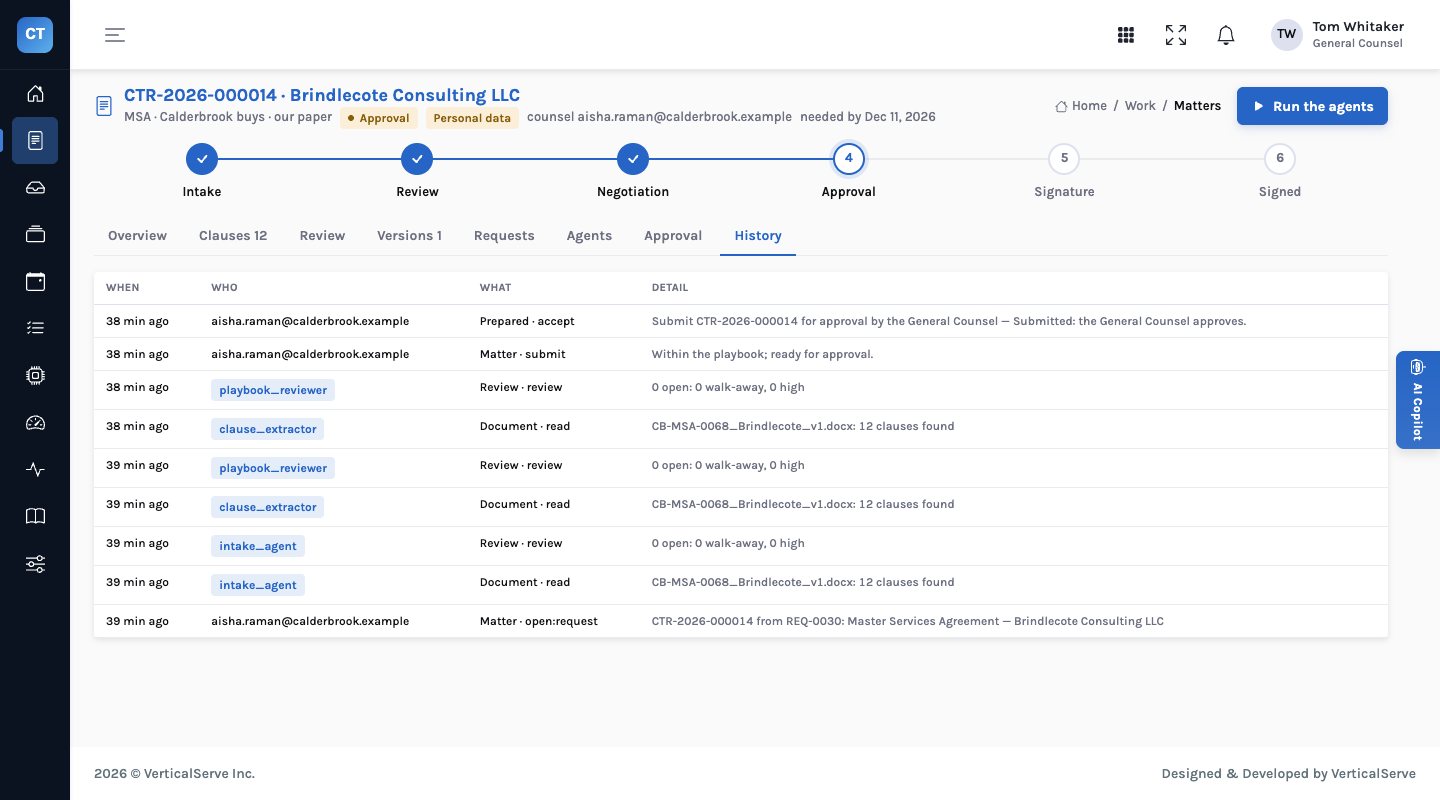
Every step is audited with who took it — a person or an agent, and if an agent, which one and at what autonomy level. When a matter is approved, rejected or withdrawn, a decision record keeps the submitter and the decider, the draft and version, each non-preferred clause’s position, severity and resolution with its note, and the outcome of every approval control at that moment. Approving needs a submission by someone else: the four-eyes rule is enforced, not suggested.
For the General Counsel
You can explain every finding from the page and line, every redline from the playbook, and every approval from the decision record. The decisions reserved to you reach you by rule.
If asked whether AI drafted contract language the company sent, the answer is no: the language is the playbook’s.
For legal operations
Agents take the preparation; the autonomy page shows how often lawyers agree with what they prepare, by agent and action.
For the board
AI in the legal function is bounded by design: nothing is sent, accepted, approved or signed without a person, and the model can be switched off without losing the review.
Not legal advice
This post describes how one product is built and the questions we think are worth asking. Your professional obligations depend on your jurisdiction and role; take your own advice on them.
The test of AI in contract review is whether a lawyer can check it in seconds.
Quoted page and line, positions from the playbook, redlines in approved words, consequential steps reserved to people, and a record of all of it. Ask for those, whichever tool you choose.