Kelbrook Chemicals is a Calderbrook customer. It already has a master agreement with Calderbrook, and now wants a SaaS order form under it for compressor fleet monitoring: twelve months, US$323,000. Kelbrook sends its own paper. Section 8.1 of the order form lets Kelbrook assign it “without Calderbrook's consent, including to any acquirer of its business.” The master agreement it hangs from says the opposite: neither party may assign without the other’s prior written consent. Read alone, the order form has a medium-severity deviation. Read with its parent, it has a conflict.
In short
- An order form is never read alone. It sits under a master agreement, and the two have to agree, or say clearly which one wins.
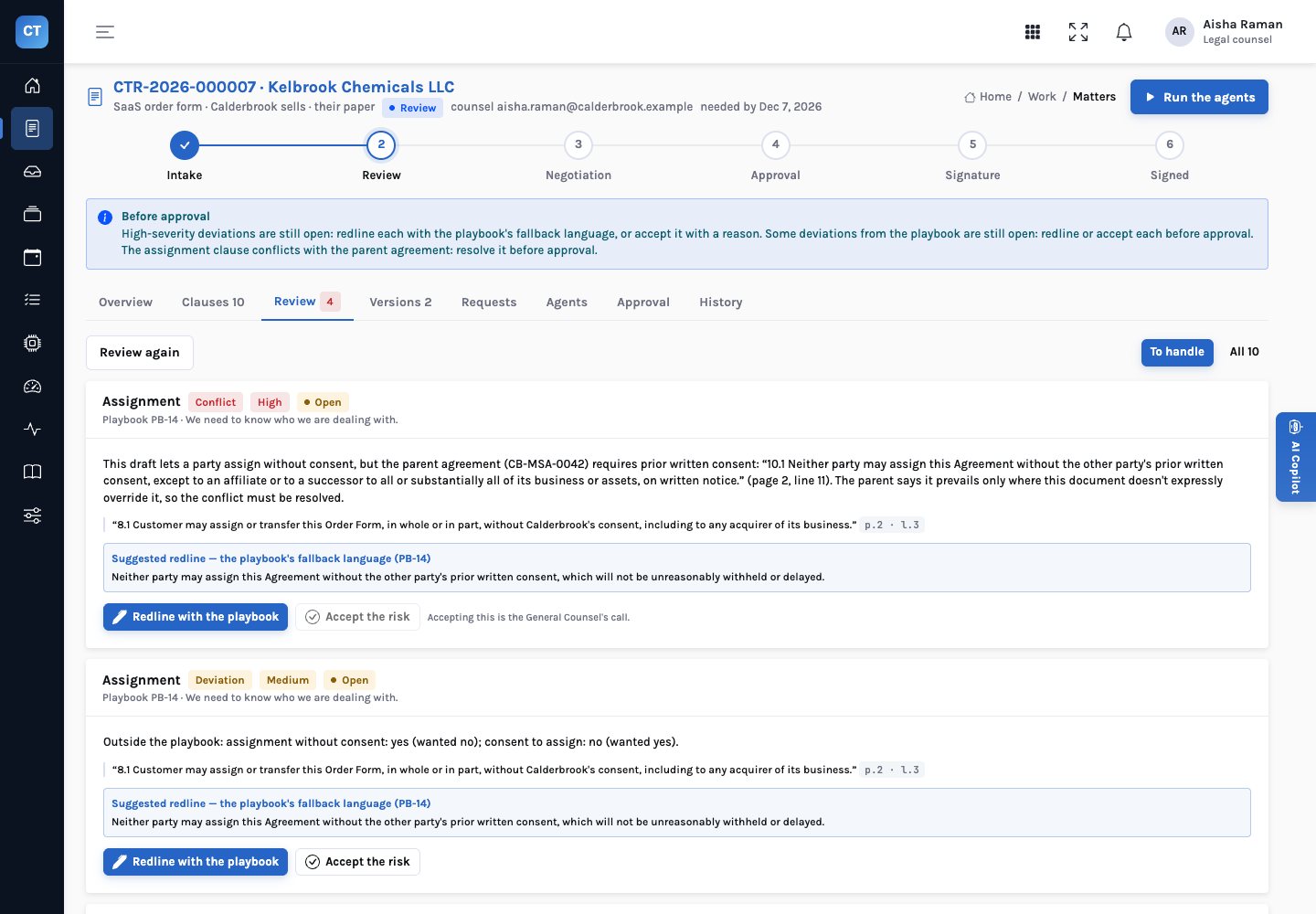
- InsightContracts reads the parent’s executed copy and compares its assignment clause with the draft’s. Free assignment in the child where the parent requires consent is raised as a conflict, high severity, quoting both clauses with their page and line.
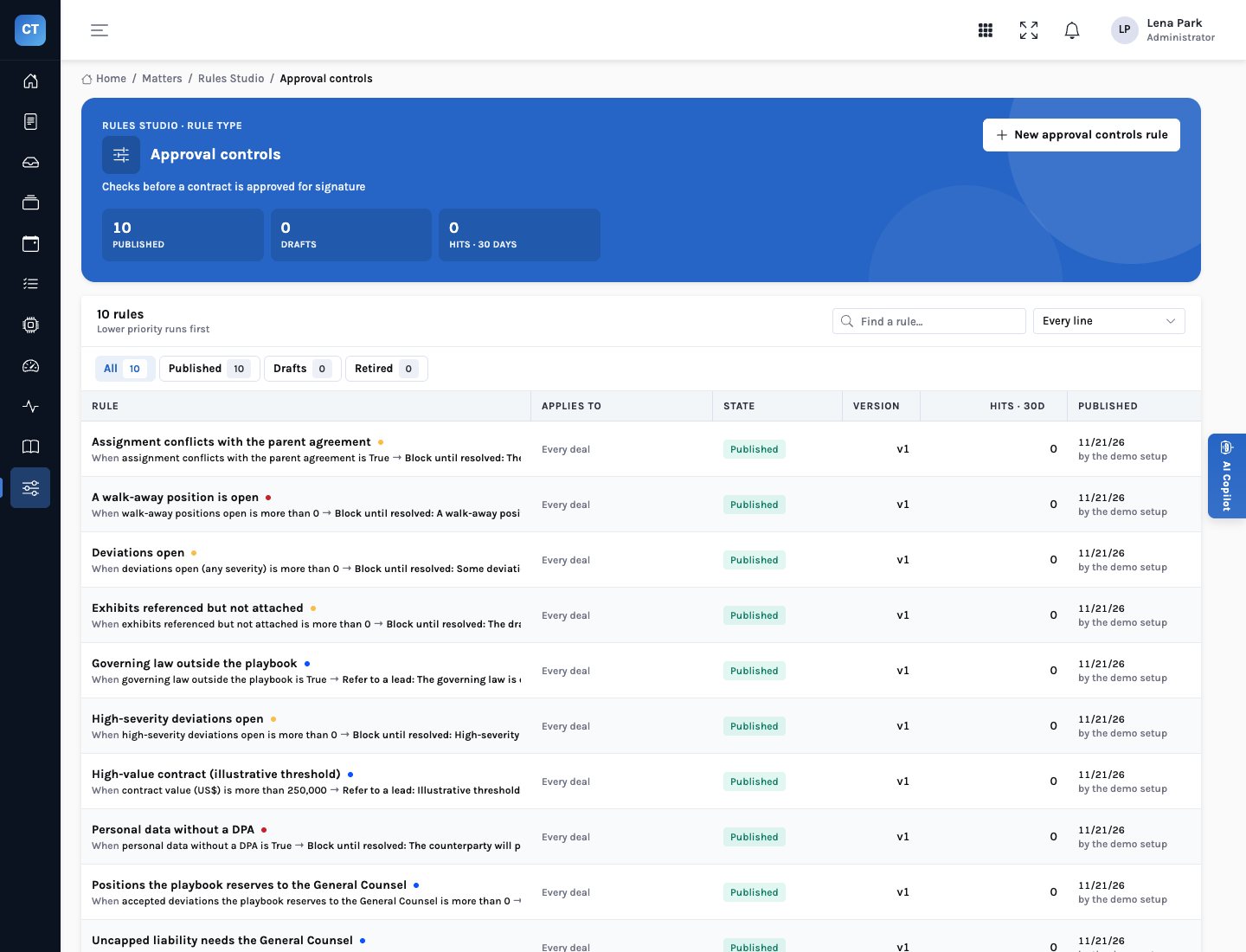
- The conflict blocks approval under its own control, separately from the playbook deviation on the same clause.
- The fix is the playbook’s language, verbatim, and it is the counsel’s to send. The matter also needs the General Counsel for governing law and value before it can be approved.
The situation
This matter is on InsightContracts’ demo data: Calderbrook Systems, Inc. and Kelbrook Chemicals
LLC are fictional, and the playbook is illustrative, not legal advice. The matter is
CTR-2026-000007, from intake request REQ-0007: a SaaS order form
(CB-ORD-0052) on Kelbrook’s paper, with Calderbrook as the seller, under the master
services agreement CB-MSA-0042.
| The order form (this draft) | The master agreement (the parent) | |
|---|---|---|
| Document | CB-ORD-0052_Kelbrook_v2.docx, counterparty’s revised draft | CB-MSA-0042, executed copy in the repository |
| Assignment | “8.1 Customer may assign or transfer this Order Form, in whole or in part, without Calderbrook's consent, including to any acquirer of its business.” (page 2, line 3) | “10.1 Neither party may assign this Agreement without the other party's prior written consent, except to an affiliate or to a successor to all or substantially all of its business or assets, on written notice.” (page 2, line 11) |
| Read as | Free assignment by the customer; no consent | Consent required, with an affiliate and successor exception on notice |
The detail on the finding adds the third fact that matters: the parent says it prevails only where the document under it doesn’t expressly override it. An order form that expressly allows assignment without consent is exactly that kind of override, so the conflict can’t be left to the precedence clause to sort out.
Why this gets missed
- The parent isn’t on the desk. The reviewer has the order form open. The master agreement was signed two years ago, by someone else, and lives in the repository.
- “Subject to the MSA” feels like protection. Most order forms say the master agreement governs. Reviewers assume that settles any inconsistency, without reading how the precedence clause is worded.
- Customer paper on a sale is read for commercial terms. When Calderbrook is the seller, attention goes to price, payment and the platform; boilerplate like assignment gets a lighter read.
How InsightContracts reads the family
Before the playbook comparison, the review gathers facts from around the draft: a DPA signed under the parent, a DPA on the matter, and the parent’s assignment clause, read from its executed copy by the same clause reader. Then two checks run on the same clause:
Two findings from one clause: against the parent agreement, and against the playbook.
The playbook comparison finds what it would find on any order form: “Outside the playbook:
assignment without consent: yes (wanted no); consent to assign: no (wanted yes).” That is
a medium-severity deviation under PB-14. The parent comparison finds something the
playbook alone can’t: a conflict with a contract Calderbrook has already signed. It is high
severity and has its own approval control.
Everything else on the draft
The assignment conflict is the finding unique to this matter, but it isn’t the only one open. The playbook reviewer found six clauses within the playbook and four findings to handle:
| Finding | Position | Severity | Quoted from the draft |
|---|---|---|---|
| Assignment vs parent | Conflict | High | §8.1, page 2, line 3 |
| Assignment | Deviation (PB-14) | Medium | §8.1, page 2, line 3 |
| Governing law | Deviation (PB-11), approver the General Counsel | Medium | “… governed by the laws of the State of Texas …” (page 2, line 7) |
| Termination | Deviation (PB-04) | Medium | “7.1 Neither party may terminate this Agreement for convenience during the Initial Term.” (page 1, line 39) |
Kelbrook’s revised draft had already moved on one point. Between the first and second drafts,
payment went from seventy-five days to forty-five, taking it from a deviation to the playbook’s
fallback for a sale (PB-13). The other findings carried over unchanged.
Calderbrook is the seller here
The playbook has positions for both sides. On a sale, payment terms come from PB-13 (the customer pays within thirty days, forty-five as fallback) and intellectual property from PB-08 (Calderbrook keeps its platform). Calderbrook’s role is recorded on the matter at intake, so the order form was compared with the seller’s positions, and section 4.1, keeping “all rights in the Calderbrook Platform”, came out preferred.
Who does what
SaaS order form on the counterparty’s paper, no personal data declared; nothing missing, the review can go ahead.
Ten clauses from the order form, each with page and line; the parent’s assignment clause read from the executed copy of CB-MSA-0042.
Four findings open, one of them the high-severity conflict. Prepares the review summary.
The playbook’s fallback language for each: PB-04 termination, PB-11 Delaware law, and PB-14 consent to assign. Held for the counsel.
Redline the assignment clause back to consent, or accept with a reason. A high-severity conflict can be accepted only by the General Counsel.
The redline package is held on the Requests tab until a person sends it. Kelbrook answers through a link, without a login.
Texas law and the value above the illustrative threshold each refer the matter to the General Counsel, who cannot be the person who submitted it.
What the controls say
| Control | Outcome | On this matter |
|---|---|---|
| Assignment conflicts with the parent agreement | Block | Open conflict with CB-MSA-0042 |
| High-severity deviations open | Block | The conflict is high |
| Deviations open | Block | Four findings open |
| Governing law outside the playbook | Refer | State of Texas |
| High-value contract (illustrative threshold) | Refer | US$323,000 is above the illustrative US$250,000 |
What the counsel would weigh
Assignment by a customer is a commercial question as much as a legal one. Calderbrook might be content for Kelbrook to assign to an affiliate or a buyer of its business on notice, which is what the master agreement already allows. What the order form proposes goes further: assignment of all or part of it, to anyone, without consent. The playbook’s fallback brings it back to consent not unreasonably withheld; the parent’s own wording would also resolve the conflict. Either is the counsel’s proposal to make, not an agent’s.
One more fact from the repository is worth the counsel’s attention: the renewals calendar shows
the parent agreement, CB-MSA-0042, ending on Jan 6, 2027, while this order form would
start on Dec 27, 2026 for twelve months. An order form that outlives its master agreement raises its
own questions, and the place to ask them is in the same negotiation.
What it means for each audience
For the General Counsel
The company’s signed master agreements keep doing their job. An order form can’t quietly undo a consent requirement that was negotiated two years ago.
If the conflict is ever accepted, it is the General Counsel who accepts it, with a reason on the record.
For legal operations
Nobody has to remember which master agreement an order form sits under, find its executed copy and compare clauses by hand. The parent’s clause arrives quoted, with its page and line.
The same check runs on every order form, SOW and supply agreement under a parent.
For the board
Customer and supplier relationships stay governed by the terms the company agreed, not by whichever document was signed last.
That matters most in exactly the moment assignment clauses exist for: when the other side is sold.
What to be careful about
- The check needs the parent’s executed copy. If the master agreement isn’t in the repository, or isn’t linked to the order form, there is nothing to compare with.
- It compares assignment, not everything. Other inconsistencies between a child and its parent, such as a different liability cap or governing law, are found against the playbook, not against the parent. A lawyer should still read the precedence clause.
- Precedence wording varies. “Prevails unless expressly overridden” and “always prevails” lead to different answers. The finding quotes what the parent says; what it means for your contract is a legal judgement.
Every order form is two contracts: the one on the desk and the one it sits under.
Read the child against its parent as well as the playbook, and resolve a conflict before signature, not after an acquisition.